How AI Is Changing SEO: A 2026 Guide
This article is the data companion to the pillar guide, Getting Cited in AI Search. It looks at the evidence behind the shift (click-through rates, citation studies, Google's policy changes) and what to measure differently. The pillar covers what to do about it: readable pages, fan-out coverage, authority, reporting and a 30-day plan.
The last three core update cycles have confirmed something that sounded like marketing-blog conspiracy theory just two years ago: Google no longer rewards a good ranking with a click. Increasingly, it gives the answer itself, and keeps the user on its own page. For an industry that spent two decades measuring success by organic visits, this is the biggest shift in the rules of the game since the mobile index rollout.
Table of contents
- The numbers behind the theory
- New metrics worth tracking
- What still works: the old principles that remain essential
- What's new: tactics built for the AI era
- Practical steps for 2026
- Conclusion
- Sources
The numbers behind the theory
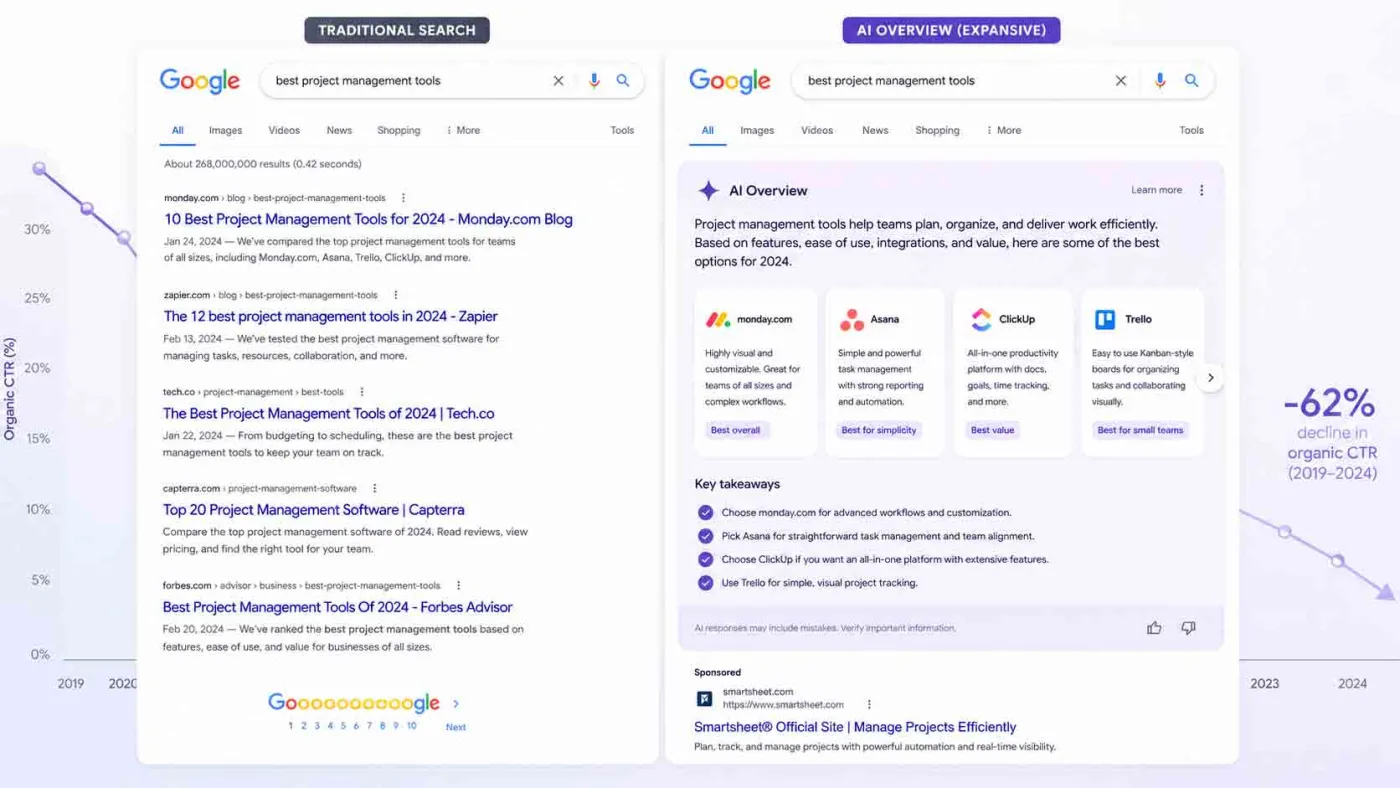
The most extensive study available, by Seer Interactive, tracked 53 brands, 5.47 million queries and 2.43 billion impressions from January 2025 to February 2026. An earlier Seer dataset of informational queries (3,119 search terms across 42 organizations, June 2024 to September 2025) showed average organic CTR (click-through rate) on queries where an AI Overview appears falling from 1.76% to 0.61%, a drop of roughly two thirds. In the 2026 update, that CTR rose from a low of 1.3% in December 2025 to 2.4% in February 2026, an 85% jump in two months. It is still below the 3.8% CTR on queries without an AI Overview, and Seer's own advice is to plan on the assumption that AI Overviews will keep suppressing organic CTR for informational content.
An independent Ahrefs analysis of 300,000 keywords reached a similar conclusion: the top-ranking page's CTR fell by 58% when an AI Overview appeared. Pew Research Center, in a panel study of 68,000 queries, found that only 8% of users click a traditional result when an AI overview is present, versus 15% when it isn't.
A randomized field experiment adds the causal evidence. Agarwal and Sen randomly assigned 1,065 desktop Chrome users to see Google with or without AI Overviews over two weeks in January and February 2026, and pre-registered the study with the AEA RCT Registry. When an AI Overview appeared, it reduced outbound organic clicks by about 40% (39.8% in the current version of the paper) and raised zero-click searches by about 35%, with no measurable improvement in how users rated their search experience. That sits in tension with Google's public statements about the benefit to users. The authors describe some of the results as exploratory, and the sample is active desktop Chrome users rather than all searchers, so read it as strong evidence, not a universal constant.
New metrics worth tracking
Taken together, these studies show organic search splitting into two separate realities. Queries without an AI Overview are becoming more valuable: their CTR rose from 2.8% in January 2025 to 3.8% in February 2026, since Google hands "quick answers" to the AI summary there, while users who still click through are looking for deeper analysis. At the same time, being cited matters. According to Seer Interactive's data, brands cited inside an AI Overview earn 35% more organic clicks and 91% more paid clicks than brands the summary doesn't mention, and cited pages get more clicks than uncited pages on the same results page, though both still get fewer clicks than searches with no AI Overview.
That means the old focus on ranking position alone no longer fully fits the new reality. Instead of tracking rank in isolation, the relevant metrics for 2026 become:
- AI Overview appearance rate for target queries. It varies wildly by industry: BrightEdge's analysis found AI Overviews on as many as 88% of healthcare queries and 83% of education queries.
- Citation rate inside AI answers, regardless of classic organic rank. Ahrefs, analyzing 863,000 keywords and 4 million AI Overview URLs, found that 38% of cited pages also rank in the organic top 10 for the same query, down from 76% in its July 2025 study. About 31% rank between 11 and 100, and about 31% rank beyond 100. BrightEdge, with a different method, put the top-10 overlap at about 17%. The studies are not directly comparable and there is no single true number, but they point the same way: AI Overviews cite far more content from outside page one than most marketers expected. That is what you would expect from query fan-out, which Query Fan-Out and AI Crawlers: A Deep Dive for Nonprofits explains in detail.
- CTR measured separately for queries with and without an AI Overview, since blending the two datasets produces a misleading picture of campaign performance.
What still works: the old principles that remain essential
Despite all the change, SEO's foundations haven't collapsed. Rankings still matter: even in the Ahrefs data, roughly seven in ten cited pages sit within the top 100 results. E-E-A-T (experience, expertise, authoritativeness, trustworthiness) has, paradoxically, become more important than ever, because AI systems still have to decide whom to trust when choosing a source to cite. Content quality, page load speed, and a healthy backlink profile remain prerequisites just to get a page indexed and considered as a candidate for an AI answer at all.
Google also closed a gap on May 15, 2026. It clarified in its Search Central documentation that its existing spam policies, including those on scaled content abuse, doorway pages and link manipulation, apply to generative AI responses in Search, including AI Overviews and AI Mode. It was a clarification rather than a new rule set, but it removes any assumption that the AI layer is a policy-free zone.
What's new: tactics built for the AI era
Several tactics are specifically relevant to "answer engine" optimization (AEO), tactics that essentially didn't exist in the standard SEO vocabulary two years ago.
Structured data (schema markup). Google officially states that no special schema is required to appear in an AI Overview. Some paired-page experiments report that the page with properly implemented schema was the one cited, but that is correlation from small tests, not a documented cause. The pillar and the deep dive treat schema the same way: a way to remove ambiguity, plausible and cheap, not a citation lever. Article and Organization markup are worth having (for a nonprofit, Organization plus NGO), and the deep dive has a working example. Use FAQPage only if you genuinely have FAQ content, and do not expect a rich result from it. One rule holds regardless: schema must match the page's visible content, because markup that doesn't match breaks Google's structured data guidelines.
Clear answers up front. AI systems favor pages that answer the question directly within the first few sentences, then build out context afterward, the reverse of the classic essay structure that builds toward its point. The full method is in How to Write Content That AI Models Actually Cite?.
Named sources and expert quotes. The Princeton-led study (Aggarwal et al., KDD 2024) found that adding quotations, statistics and citations raised a source's visibility in generative answers by up to about 40%, with quotations performing strongest in its tests. It tested generative engines in general rather than AI Overviews specifically, so treat it as a strong direction, not a guarantee.
Tracking AI bots in log files. Checking whether the search bots (OAI-SearchBot, Claude-SearchBot, PerplexityBot) are even reaching your priority pages has become as important as monitoring Googlebot. Structured data on a page these bots never visit is simply invisible to them. Note that GPTBot and ClaudeBot are the training crawlers, a separate decision that the pillar and the deep dive cover, including which ones to allow and why Google-Extended is not the Google control.
Practical steps for 2026
- Split your reporting. Track CTR and conversions separately for queries with and without an AI Overview, instead of looking at a single blended average that hides the real picture. Search Console's AI performance report shows impressions but not clicks (the pillar explains it), so this split will usually need data from a third-party tracking tool.
- Implement JSON-LD schema for Organization and Article content, aligned strictly with the page's visible text. The deep dive has the details.
- Restructure key pages so the answer to the main question sits in the first two or three sentences. See the writing guide linked above.
- Strengthen E-E-A-T signals. Name your authors, add their bios and credentials, and bring in quotes from real experts with full name and title.
- Check your log files to confirm the major AI search bots are actually reaching the content you want cited. The crawler access check in the deep dive takes about fifteen minutes.
For how to sequence this over a month, and how to measure the result, follow the pillar's 30-day plan.
Conclusion
The core message for 2026 isn't that SEO is dead. It's that it's transforming from a discipline built around position into one built around citation and trust. As industry analysts have vividly put it, planning traffic around old CTR benchmarks is about as reliable as budgeting your electricity bill using pre-2022 prices. Companies that adapt how they measure success, their technical infrastructure, and the way they write content to this new reality will hold a real advantage, while those still tracking only the old search-results position will find it harder and harder to explain why the numbers aren't moving.
For the practical path from here, continue with the pillar: Getting Cited in AI Search.
Sources
- Seer Interactive, AIO Impact on Google CTR: 2026 Update, and Search Engine Land's coverage, Google AI Overviews CTR shows early signs of recovery
- Seer Interactive, AIO Impact on Google CTR: September 2025 Update (3,119 informational queries, 42 organizations)
- Ahrefs, analysis of 300,000 keywords (position-one CTR) and of 863,000 keywords / 4 million AI Overview URLs, as reported by Search Engine Journal
- Pew Research Center, panel study of 68,000 queries
- Agarwal and Sen, The Impact of Google AI Overviews on Publisher Traffic and User Experience: Evidence from a Field Experiment (SSRN; pre-registered with the AEA RCT Registry)
- BrightEdge, AI Overview coverage by industry and citation overlap (February 2026)
- Google Search Central, Spam Policies for Google Web Search, as reported by Search Engine Land, and Guidance on Generative AI Content
- Aggarwal et al., GEO: Generative Engine Optimization, Princeton and others, KDD 2024